
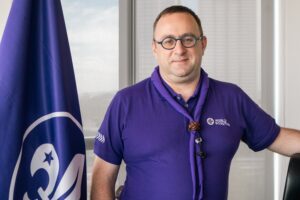
David Berg, Secretary General. By World Scouting Pablo Cuadra Caro
For World Scouting’s Secretary General David Berg, what started as fun Sunday mornings would become a journey spanning decades, countries and continents, taking him from a Belgian Cub Pack to the executive leader of the world’s largest educational youth movement in the world.
“My Scouting journey started like any normal Scout story. I grew up in Belgium and according to my parents, I was a shy kid. They decided I needed to be in a place where I could make friends and work in a team. One morning they took me to the Cub Pack at the FOS Open Scouting Organization. There, I learned to lead, how to fail and take insights from that going forward, and I learned to be a team player. Those early lessons of learning by doing defined how I work in teams today,” explains David.
Some of his earliest Scouting memories are rooted in the simple experiences that have connected generations of Scouts – campfires, hiking, nature, friendship and reflection. “I will always associate campfires and reflection with my time as a Scout. I remember the evenings around the campfire, gazing into the flames, bringing me into a more reflective space within Scouting. There were a lot of skits and singing, but also that time for reflection which I enjoyed as a Scout. Then there are also the Scouting traditions. A tradition in Belgian Scouting is receiving a unique animal name based on the characteristics associated with it that you as a person possess. Mine was ‘Talpa’, the Latin name for mole. Moles live underground, can navigate complex networks and environments, and they function well on their own. I was 14 and was not overly social, while being good at solving complex questions. I remembered getting my name from the Group as it was something special.”
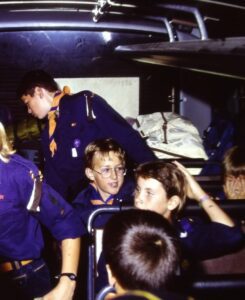
David joined as a Cub. Supplied World Scouting.
To this day, David really enjoys getting outdoors and reconnecting with nature. “I remember many expeditions which developed a deep-rooted love for hiking and being outdoors. Having those experiences developed a passion for being on the road, for travelling and moving from A to B, and exploring new environments. This has proven to be very useful in my line of work. I learned technical skills from hiking, orientation and mapping. Even though, today, we can use our phones instead of a compass to navigate, I still carry a compass and a whistle when hiking. I also learned a lot of life skills, especially how to work in a team and lead a group of people with different opinions. At first, I wanted to do everything myself. But while learning how to cook and working on pioneering projects, I learned to be a team player. Perhaps most importantly, I learned to listen. Listening and trying to understand why people have different views; those are key strengths for someone in a leadership role. Working in a team also taught me how to internalise our Scouting values such as respect, dialogue, and giving back. Even if we disagree, having conversations in a respectful way to come to a compromise builds dialogue skills and understanding. Key values for young people to learn.”
But perhaps the most important thing Scouting gave him as a young person was a place where he belonged. “As a teenager, when many young people found other interests, I stayed in Scouting. I had a different group of friends at school who weren’t connected to Scouting, but my Scouting friendships were one of the reasons I stayed. Scouting was a place where I felt accepted, no matter what. It didn’t matter who you were or whether you were good at a subject or sports or not. Everyone had a place, and you could find the strength in everyone. You were welcome, no matter what.”
Good leadership can change perceptions and build skills for life. Through a Scout leader, David discovered that Scouting extended far beyond his local Group. “One of our leaders was active at a national level and was also the International Commissioner. He encouraged me to attend international camps and experience Scouting across borders. One of the first international camps I attended was called ‘InterCamp’ which brings together different European countries. At the time, we had Scouts from Canada and the USA too, Groups came from these countries’ military bases across Europe. It was very casual. You came with your Scout Group and brought your own food and tents, which meant the camp was really focused on connecting with your peers. This experience fundamentally changed my understanding of the movement. It opened my eyes to the added value of Scouting and meeting people from across borders. I realised that we have more in common than what separates us.”
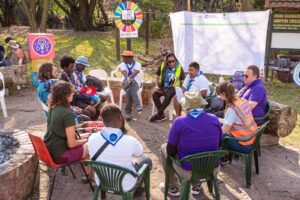
2nd Africa Scout Moot Peace Circle. By Dawn Ledbitter
Another highlight for David was attending the 18th World Scout Jamboree in the Netherlands as a 15-year-old in 1995. “If you watched the news at that time, there was lots of coverage of war and conflict. But when you arrived at the Jamboree, young people from around the world were coming together as equals in peace. I remember the Peace Circle where youth from Yugoslavia, Rwanda, Israel and Palestine were talking about their experiences and exchanging views and ideas. The discussions were respectful, without always agreeing. Scouting facilitated a conversation, and it was very powerful.” These experiences remain central to David’s understanding of what Scouting can offer the world.
His leadership journey developed gradually. He moved through different levels of Scouting, eventually becoming Chief Commissioner for the National Scout Association in Belgium before taking on senior leadership roles within the World Scout Bureau. The realisation that Scouting would define his career came when he became the Chief Executive in Belgium. He also worked for Oxfam managing the volunteering and advocacy portfolio, before being drawn back to Scouting.
Today, David serves as Secretary General of World Scouting, a role he never imagined when he was a young Cub. “I believe that leadership is inseparable from service. I serve as Secretary General so I can give back. The role is both humbling and demanding. It’s intense, but incredibly rewarding. There is a lot of travelling involved, which has given me a unique perspective of Scouting around the world. I get to see Scouting in all its diversity and often I am inspired by what I see young people achieve. I am humbled to be able to do it together with the Board and a motivating and inspiring team of staff and volunteers.
My experience as a Scout, a volunteer and someone who has worked for a National Scout Organization is very helpful as it gives me insights into how things work. I can reflect on my own experiences and think about what would have worked for me as a young person and as a Chief Commissioner. That has helped me in my role because I can relate to NSOs and young people’s experience in Scouting.”
David’s international experience has reinforced his belief in what Scouting can offer. One of the experiences that stands out is Haiti. Following the devastating earthquake in 2010, David visited the country several times and saw first-hand the role Scouting played in local communities. “We supported Scouting in Haiti through the Messengers of Peace Fund. I was inspired by the resilience and self-reliance of communities and the impact of 60,000 Scouts on the island. They were giving young people a safe space to be themselves and learn; creating opportunities for humanitarian response and making a real impact on young people who were sometimes living in difficult circumstances.” David recalls seeing international organisations wanting to work directly with Scout Groups because they recognised the trust and reach that Scouting had within the country.
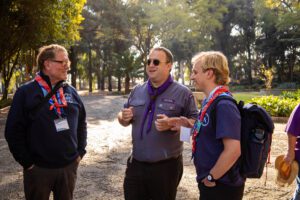
David during the excursions at the 2nd Africa Scout Moot. Photo by World Scouting Pablo Cuadra Caro
For David, the future of Scouting depends on young people being given a genuine voice in shaping it. “Scouting needs to renew itself and stay in tune with the views and needs of young people. That means young people should not simply be consulted after decisions have already been made. They should be part of the discussions where decisions are made as an intergenerational team. This enables young people to have a voice and benefit from the expertise of other generations. Youth participation is particularly important as Scouting responds to real challenges that young people face today, such as climate change, peace and other issues. As an organisation, it is important to live this and to make sure that the voices of young people are part of decision-making.
Helping young people know what it is to lead is key. Developing youth leadership is woven into all the different levels in Scouting, from local Cub Packs, to Groups, National Scout Organizations and within the World Scouting structures. We need to continue to show the importance and power of Scouting to empower young people to speak out, have a voice and speak where local and national decisions are made. This is where National Scout Organizations play an important role. This is essential for Scouting to remain relevant. A good example is our 37 Youth Representatives from all around the world who are trained to advocate at international institutions, including the United Nations and the African Union, on topics such as peace, education and sustainability. Not only do they speak with authority, but their voices are also welcomed, which is inspiring for what comes next.
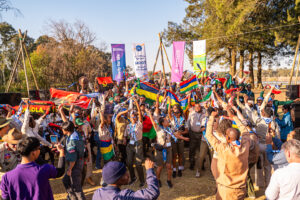
2nd Africa Scout Moot, World Scouting Jonathan Law
In a world where communities can become divided by nationality, ethnicity and ideology, David says one of the things that gives him hope is seeing young people discover through Scouting how much they have in common. “Young people being able to come together and realise that they have much more in common than their differences gives me hope. These are the voices of people who will leave our world a bit better behind than they found it. Herein lies the power and future of Scouting. South Africa is a good example of this, as we recently celebrated the diversity of Scouting in the country, but also on the Continent, at the 2nd Africa Scout Moot.”
Despite the international responsibilities of his role, David still finds joy in simple outdoor pursuits. “I enjoy doing things in which you cannot hold a phone – like skiing, hiking, and motorbiking. I also enjoy Lego and board games. That is what I love.”
Ask David to explain Scouting in one sentence and his answer is simple. “Ready for life. This is what Scouting does. It gives you skills for whichever life you choose and enables you to learn those in a fun way. Because if it’s not fun, it’s not Scouting.” It is a fitting description of a journey that began with a shy young Cub who needed Scouting to help him find his place and eventually found himself in a position where he could help shape opportunities for millions of young people around the world. And one thing you can also be sure of is when he travels the world for work or leisure, he packs his Scout scarf and a roll of duct tape!